
Building Liberty

The Statue of Liberty is one of the world’s greatest icons, so recognizable that it is used as a lost marker of all human civilization in (spoiler alert) Planet of the Apes. It has appeared in countless movies, photographs, souvenirs and comics.
Few things represent AMERICA quite so hard as well, and it’s easy to feel like she has always been there, towering over New York Harbour. Yet Liberty is a relatively modern construction, built by French ideas and manufacturing ingenuity. What is her story, and what can it teach us today?

Liberty was conceived by a Republican jurist Edouard de Laboulaye and Alsatian sculptor Auguste Bartholdi and started as a simple idea about an intangible concept: freedom, bound in physical dimensions.
Bartholdi was an avid photographer, and the visual documents of his travels provided the raw material for his own artistic work. In travels around the world he photographed ancient statues like the Colossi of Memnon in Thebes, and also photographed new methods of iron and steel construction in viaducts and railway engineering.
A trip to the Middle East inspired his first drawings that eventually became Liberty, positioned on a large stepped pyramid. The original design came to him in a dream about a massive statue intended for the mouth of the Suez Canal. After that project did not move forward, his attention shifted to New York.
In Paris, a copper plumbing and smelting facility was designated as the place where Liberty would be built. It took four years to complete the Parisian stage of Liberty’s construction. Her iron skeleton was started by Viollet-le-Duc, who designed the iron spire of Notre Dame, and then it was completed by Gustave Eiffel. Yes, that same Eiffel.
Other local photographers meticulously documented every stage in Liberty’s construction, which was truly incredible to behold and included wooden structures, templates, life-size plaster models, and exterior copper sheets that were carefully hammered and shaped by hand.
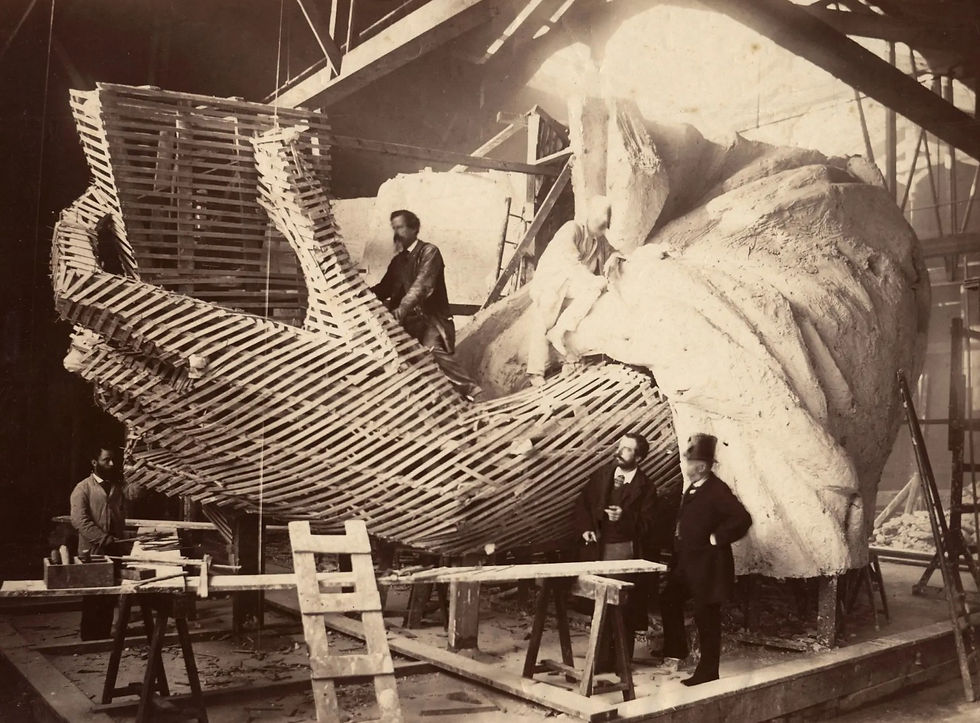
The construction methods used in Liberty represented the very latest innovations in structural engineering. Ironically, to produce what looked like an ancient colossus, Bartholdi relied on a cutting edge iron structure inside. She was innovative, draped in classical ideas, and hollow. The analogies for America as a political and social project could go on and on.
Liberty the statue shares so much in common with the democratic experiment, which itself is a modern thing composed of many parts. At its core, there is nothing solid or rational, only an idea and feeling: and around it, a framework, on which many pieces hang and join together. Behind the scenes of democracy there is nothing glamorous. Just a unique and innovative structure on which all the world’s hope for freedom hangs. No big deal.
Liberty is modern on the inside. Though her shell echoes monumental sculpture from ancient forms, her construction was built as a massive curtain wall. Her surface is entirely decorative. All of the structure holding her up is on the inside, disguised behind her body. Weight is distributed across the structure rather than solely up and down. To some extent, she defies gravity.
This shortened excerpt is from the Kinbright Writes newsletter.
Sign up to receive more insights and subscribe at clarecameron.ca


